


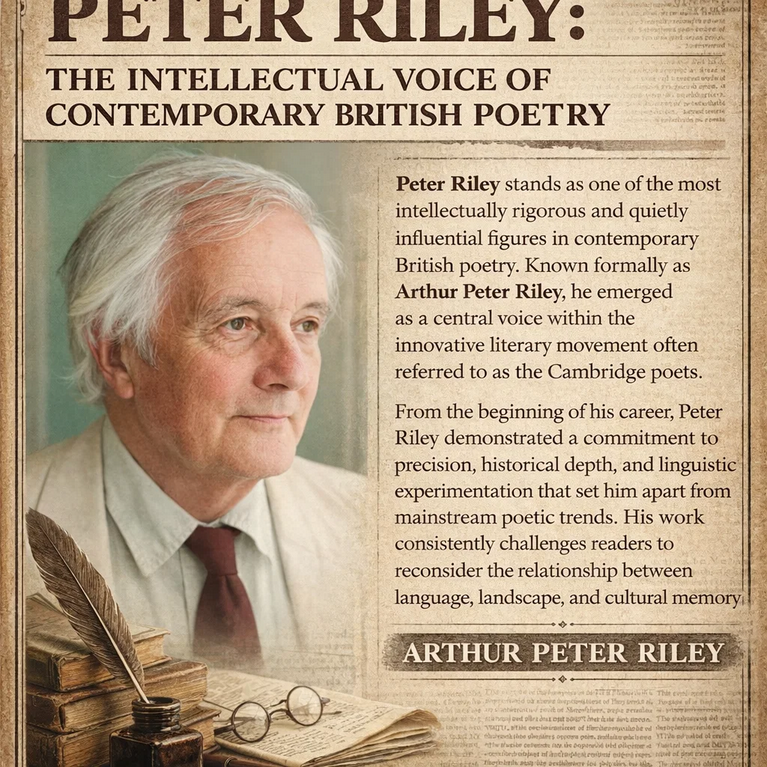
Peter Riley is a distinguished contemporary English poet, essayist, and editor whose work occupies an important position in modern British literature. Best known as a leading figure among the Cambridge poets, Peter Riley is associated with a tradition of innovative writing that values intellectual rigor, historical awareness, and linguistic precision. Rather than pursuing mainstream popularity, he developed a body of work that speaks to readers willing to engage deeply with poetry as a serious form of thought. Over several decades, Peter Riley has contributed poetry, criticism, and editorial leadership that continue to influence experimental literary culture in the United Kingdom.
| Field | Details |
|---|---|
| Full Name | Arthur Peter Riley |
| Known As | Peter Riley |
| Profession | Poet, Essayist, Editor |
| Nationality | English / British |
| Date of Birth | Not publicly disclosed |
| Place of Birth | England |
| Age | Not publicly available |
| Education | Cambridge University |
| Field of Study | History |
| Literary Movement | Cambridge Poets / Cambridge School of Poetry |
| Associated With | J. H. Prynne |
| Genres | Innovative Poetry, Experimental Poetry, Literary Criticism |
| Known For | Historically informed poetry, landscape-based writing, intellectual rigor |
| Notable Roles | Poet, Literary Critic, Editor of Experimental Poetry |
| Writing Style | Philosophical, complex, historically aware |
| Major Themes | History, land, political memory, ethics, language |
| Years Active | Late 20th century – Present |
| Current Status | Active in literary and academic circles |
| Recognition | Respected figure in British innovative poetry |
| Influence | Experimental and Cambridge-based poets |
| Language | English |
Early Life and Background of Peter Riley
Arthur Peter Riley was born in England during the post-war period, a time when British society was undergoing major political and cultural transformation. Growing up in this environment shaped his sensitivity to history and social structures, elements that later became central to his poetry. From an early age, Peter Riley showed strong intellectual curiosity, particularly toward reading, language, and historical narratives. These interests were not purely academic; they reflected a deeper concern with how the past shapes present reality. His formative years laid the foundation for a literary career defined by seriousness and reflection rather than personal exhibitionism.
Education and Cambridge Influence
A defining stage in Peter Riley’s life was his education at Cambridge University, where he studied history. This academic background profoundly shaped his approach to poetry. Historical study trained him to analyze evidence, question authority, and recognize continuity between events and structures across time. At Cambridge, Peter Riley encountered a vibrant intellectual environment that encouraged experimental thinking and critical debate. Rather than treating poetry as emotional self-expression, he came to see it as a disciplined form of inquiry. This perspective aligned him with a group of writers who would later be recognized as central to innovative British poetry.
Peter Riley and the Cambridge Poets
Peter Riley is widely recognized as a key figure among the Cambridge poets, a loosely connected group rather than an organized movement. These writers shared a resistance to conventional lyric styles and commercial literary trends. Instead, they emphasized difficulty, precision, and philosophical engagement. Within this context, Peter Riley developed a poetic voice that balanced analytical thinking with attention to material reality. The Cambridge poets valued close reading and intellectual seriousness, qualities that remain central to Riley’s work. His association with this tradition situates him within one of the most important centers of poetic innovation in the UK.
Relationship with J. H. Prynne
An important intellectual relationship in Peter Riley’s career was his association with J. H. Prynne, one of the most influential poets to emerge from Cambridge. While Riley never adopted Prynne’s style, the dialogue between them reinforced shared values regarding language and responsibility. Peter Riley engaged critically with Prynne’s ideas about politics, meaning, and poetic form, adapting them to his own historical concerns. This relationship strengthened his commitment to poetry as a rigorous intellectual practice. It also positioned him within a wider conversation about the ethical role of literature in modern society.
Literary Career and Development
The literary career of Peter Riley developed steadily rather than rapidly. He published carefully and deliberately, allowing ideas to mature over time. This approach resulted in a body of work marked by coherence and depth. Instead of producing frequent collections, Peter Riley focused on sustained projects that explored recurring concerns from different angles. His reputation grew gradually within academic and experimental circles, where his seriousness was widely respected. This slow, consistent development reflects his belief that poetry should resist fashion and instead remain accountable to thought, history, and language.
Poetry Collections and Major Works
Peter Riley’s poetry collections are known for their engagement with landscape, history, and material conditions. Land in his work is never merely scenic; it represents ownership, labor, conflict, and memory. His poems often unfold as extended sequences, allowing arguments and images to develop patiently. Stylistically, Peter Riley favors controlled syntax and measured rhythm, encouraging close attention from the reader. His collections reveal a sustained investigation into how places record human activity over time. Each book contributes to a long-term poetic project rather than standing as an isolated statement.
Themes in Peter Riley’s Poetry
Several major themes recur throughout Peter Riley’s work. History is central, not as abstract chronology but as a force shaping contemporary experience. Landscape functions as a historical document, revealing traces of power and resistance. Political responsibility is another key concern, explored indirectly through form and structure rather than explicit argument. Peter Riley also examines language itself, questioning how meaning is produced and controlled. These themes give his poetry a distinctive seriousness. Rather than offering emotional closure, his work invites readers to confront complexity and uncertainty as part of understanding.
Style and Poetic Technique
The poetic style of Peter Riley is often described as challenging but precise. He avoids decorative language and instead favors clarity built through complexity. Sentences may extend across lines, reflecting the movement of thought rather than musical effect alone. This technique requires active participation from the reader. Peter Riley believes difficulty can be productive, encouraging deeper engagement rather than passive consumption. His style reflects the Cambridge tradition’s emphasis on intellectual honesty. Over time, this approach has become one of the defining features of his contribution to innovative British poetry.
Political and Philosophical Dimensions
Although Peter Riley rarely writes overt political commentary, his poetry is deeply informed by political awareness. He is particularly concerned with land ownership, historical injustice, and material conditions. Philosophically, his work reflects an interest in historical materialism, emphasizing how social structures persist across generations. Rather than presenting solutions, Peter Riley creates space for reflection and questioning. This approach allows his work to remain relevant across different political contexts. By embedding critique within form, he demonstrates how poetry can engage politics without sacrificing artistic complexity.
Essays and Critical Writing
Beyond poetry, Peter Riley has made important contributions as an essayist and critic. His critical writing addresses poetic form, literary history, and the responsibilities of writers working within tradition. These essays are valued for their clarity and depth, offering insight into his creative principles. Peter Riley’s criticism does not merely analyze other writers; it also clarifies his own poetic practice. Through essays, he has influenced how innovative poetry is discussed and evaluated. His prose reinforces his reputation as a serious thinker committed to literature as an intellectual discipline.
Editorial Work and Literary Contribution
Editorial work represents another significant aspect of Peter0Riley’s career. As an editor, he supported experimental poetry and maintained high standards of selection. His editorial philosophy emphasized intellectual engagement rather than commercial appeal. By providing platforms for challenging work, Peter Riley helped sustain alternative literary spaces in the UK. This contribution reflects his belief that poetry exists within a community of writers and readers. His role as an editor strengthened the continuity of innovative traditions and ensured that serious poetic work continued to circulate beyond mainstream publishing structures.
Critical Reception and Academic Recognition
Within academic and experimental literary circles, Peter0Riley has received consistent critical recognition. Scholars often highlight his coherence, discipline, and refusal to compromise complexity. His work is frequently discussed in studies of Cambridge poetry and British innovation. While he remains less visible in popular culture, his influence within serious poetry communities is substantial. Critics recognize Peter Riley as a poet who expanded the possibilities of historical and political engagement in verse. Over time, his reputation has become firmly established as one of lasting intellectual importance.
Later Life and Ongoing Influence
In later years, Peter Riley has continued to engage with poetry and criticism, refining long-standing concerns rather than abandoning them. His later work reflects maturity and clarity without simplifying ideas. Younger poets influenced by the Cambridge tradition often look to Peter Riley as a model of integrity and commitment. His influence can be seen in contemporary experimental writing that values ethics, history, and language equally. By maintaining seriousness throughout his career, Peter Riley demonstrates that innovation does not require constant novelty, but sustained attention to thought.
Conclusion
Peter Riley stands as a significant figure in modern British poetry, known for intellectual rigor, historical awareness, and ethical seriousness. As a poet, essayist, and editor, he has contributed to the development and preservation of innovative literary traditions. His association with the Cambridge poets situates him within an important cultural center, while his individual voice remains distinct. Through sustained engagement with landscape, history, and language, Peter Riley offers readers poetry that challenges and rewards careful attention. His legacy lies in demonstrating that depth, patience, and responsibility remain essential to meaningful literary work.
Frequently Asked Questions (FAQs)
Who is Peter Riley?
Peter Riley is an English poet, essayist, and editor associated with the Cambridge School of innovative poetry.
What is Peter0Riley known for?
He is known for historically informed poetry that explores landscape, politics, and ethical responsibility.
Is Peter Riley part of the Cambridge poets?
Yes, he is widely recognized as a significant figure within the Cambridge poets tradition.
What themes dominate Peter Riley’s work?
History, land, political memory, and language are central themes in his poetry.
Does Peter Riley write criticism?
Yes, he has written influential essays on poetry, form, and literary responsibility.
Why is Peter Riley important today?
His work remains relevant for its serious engagement with history, power, and poetic ethics.
Get more updates or Stories on True Stars Magazine